Wild ass
Book of JobThe Wild ass is presented as a creature defined by its freedom from human control: it inhabits wilderness and barren land, disregards the driver’s cry, and ranges across mountain pasture in search of green growth. The passage does not describe a particular encounter or act of taming. Instead, its questions make the animal’s independence itself the subject, setting a life beyond the city and the driver’s authority against familiar human expectations of service and obedience.
Identity and Freedom
The passage introduces the Wild ass through two linked questions: who sent it out free, and who loosed its bands? Their phrasing treats freedom not as a human concession or a temporary escape but as a condition belonging to the creature’s existence. The text does not name a human liberator or narrate a moment of release. Rather, it asks the listener to consider who made such an animal free, placing its untamed life within a larger account of the world and its creatures.
The image of loosened bands briefly evokes restraint, but the passage supplies no scene in which the Wild ass is captured or bound. That distinction matters: the animal is not depicted as a domesticated creature breaking out of confinement. Its liberty is the premise of the description, and the question turns that premise into a matter for reflection. The Wild ass appears as a creature whose proper condition is not defined by human ownership, usefulness, or permission.
Wilderness and Range
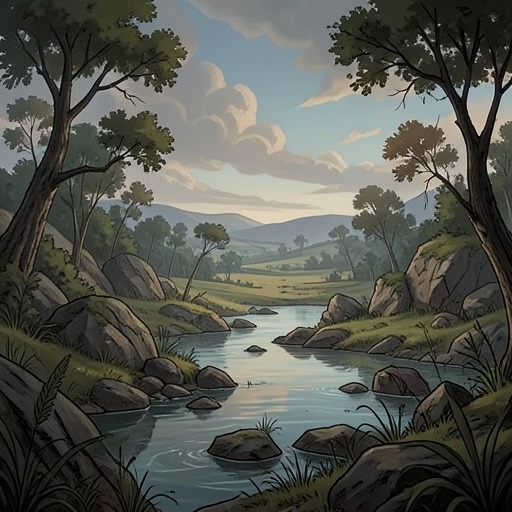
The account locates the Wild ass in the wilderness and makes barren land its dwelling. These descriptions distinguish its home from settled and cultivated spaces without suggesting that it lacks a habitat. The wilderness is not presented as an empty interval between human communities; it is where the animal lives. Barren land, too, is named as a dwelling rather than merely a place through which it passes.
Its range extends across the mountains, where the text calls the range its pasture. The wording joins terrain and sustenance: the animal’s living place is also where it feeds. It searches after every green thing, a detail that gives its independence a practical dimension. The Wild ass is not shown waiting for food to be supplied or gathered for it; the passage depicts it moving through its range and seeking what it can eat. It does not specify particular plants, distances, or seasons, and its force comes instead from the breadth of the landscape and the animal’s active search within it.
Distance from Human Direction
The Wild ass is said to scorn the multitude of the city and to pay no regard to the driver’s cry. These paired details establish two forms of distance from human order. The city represents a concentrated human world, while the driver represents an immediate voice of direction. The text places neither at the centre of the animal’s life: the Wild ass does not orient itself toward the city, and a human call does not command its attention.
The driver’s cry makes the contrast pointed without supplying a larger episode of attempted control. There is no described chase, punishment, or confrontation. Instead, the passage states the animal’s disregard as one feature of its character and way of life. Its freedom is thus conveyed not only through the questions about bands but through the absence of a human voice that can govern its movement. The Wild ass occupies a world where human commands are audible in principle yet carry no stated authority over it.
Form and Significance
The description develops through a sequence of questions and assertions rather than a story of action. The questions about who sent the Wild ass free and who loosed its bands frame the animal’s condition as something to be explained; the following details answer by showing what that freedom looks like in practice. Wilderness and barren land provide its dwelling, the city and driver mark what it disregards, and mountain pasture gives its movement a setting and purpose. The passage moves from the question of origin to the observable shape of an independent life.
The Wild ass is therefore more than a contrast to a managed animal. Its presence tests the assumption that every creature should be measured by its availability to people. The passage does not describe it as serving, returning at a call, or living within the city’s order; it describes a creature with its own dwelling, range, and search for food. By giving those details weight, the text makes untamed life part of the world under consideration in its own right. The animal’s significance lies in the gap between human expectations of direction and the life the passage depicts: a life whose course is not organized around human command.